

When war isn't self-defense
What 'revisionist' war ethics gets right—and why it still fails

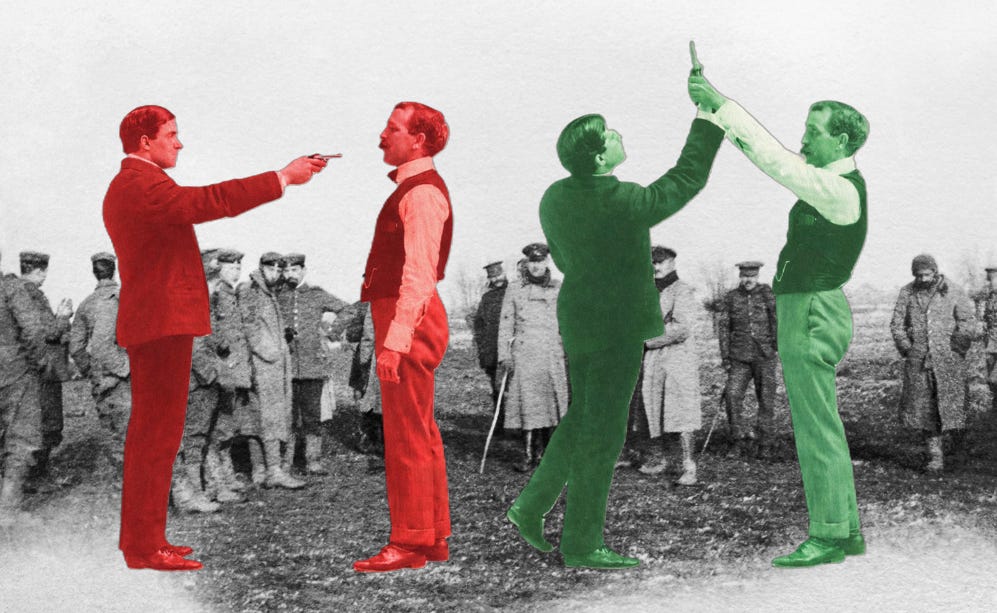
From tradition to revision
Over the past several months, I’ve been struck by how readily many people—including philosophers and ethicists—dismiss traditional accounts of the ethics of war. Instead, they often adopt individualist frameworks with little apparent hesitation. Even when I submitted papers on war ethics to philosophy journals, reviewers repeatedly pressed me on whether the (broadly traditionalist) view I defend amounts to a form of ‘collective punishment’ or relies on some ‘primordial’ mode of moral reasoning. These exchanges prompted me to articulate, more explicitly, what I take to be the insurmountable difficulties facing individualist theories of war ethics and why these approaches ultimately falter when taken from the armchair to the battlefield.1
For centuries, the dominant view in just war theory—most prominently championed by Michael Walzer—held that the laws of war are morally plausible and sufficiently robust that adherence to them is enough to fight justly. This traditional view is typically built on two central commitments. First is the independence thesis, which claims that judgments about whether it is right to go to war (jus ad bellum) can be separated from judgments about how one fights once war has begun (jus in bello). On this view, a soldier may conduct herself justly even in an unjust war. Second is the symmetry thesis, which asserts that in bello rules apply equally to just and unjust combatants: unjust combatants may permissibly kill just combatants, and vice versa.
Only in the past few decades has this orthodox picture come under sustained philosophical attack. A growing body of work, now labeled ‘revisionist,’ challenges these traditional commitments. The most influential revisionists argue that the morality of war can be fully reduced to the morality of individual acts of killing outside of war, especially in paradigmatic self-defense cases. This ‘reductive individualism,’ as it is often called, aspires to dissolve the special morality of war into ordinary interpersonal ethics. Other forms of revisionism exist, and a few recent attempts have sought to rehabilitate traditionalism by reframing it through contractarian or conventionalist lenses. Those alternatives lie beyond the scope of this essay. My concern here is specifically with the increasingly dominant individualist strain.2
To be clear, I do not think revisionism is frivolous or without insight. On the contrary, it captures several powerful moral intuitions: for example, that the killing of innocents is deeply problematic—a point revisionists highlight by noting that combatants on the ‘just side’ of a war may often count as innocents in the morally relevant sense; and that noncombatants are not always wholly detached from the machinery of war, which could, at least in principle, render them morally liable to defensive harm. Yet despite these contributions, I believe revisionist individualism suffers from profound conceptual difficulties and, perhaps more importantly, fails to offer practical moral guidance. Its principles tend to function well in abstract thought experiments but collapse under the weight of real-world complexity. For all its imperfections, the traditional view seems to remain more capable of guiding action in the moral chaos of war.
‘Deep moral principles’
A fundamental difficulty with revisionism is its tendency to impose a one-size-fits-all morality, often expressed through appeals to supposedly ‘deep moral principles’ or through the claim that there is ‘really only one morality.’ One is tempted to reply that even if there were really only one Diego Maradona, it would hardly follow that, in the context of a football match, his nose should be expected to perform the same functions as his feet. Yet revisionist accounts often proceed as if moral principles must operate uniformly across radically different domains, leading them to conclusions that verge on moral absurdity. Their criteria for necessity and proportionality, for instance, are often so exacting that they would in practice rule out nearly all wars, collapsing into a thinly veiled pacifism. They insist that moral agents in war must satisfy demanding standards of objective, or ‘fact-relative,’ justification for proportionate harm—including foreseen but unintended killings—just as in paradigmatic cases of individual self-defense. This is so despite the fact that conventional morality, as codified in international law, is typically far more permissive in wartime than in domestic life.
This foundational assumption generates deeper problems in the analogies revisionists routinely deploy, which almost always draw from domestic cases of self-defense. These analogies fail for several reasons. First, they obscure what is distinctive about war. One defining feature of war is the absence of a superior third party capable of acting as an impartial adjudicator. There is no authority with a monopoly of force powerful enough to settle the conflict from above. In domestic contexts, by contrast, such a figure exists: if a homeowner wants trespassing campers removed from their garden, state-governed police have both the authority and the coercive capacity to resolve the issue. That structural presence—of a recognized and overwhelmingly stronger arbiter—is precisely what differentiates domestic enforcement from warfare.
Second, when revisionists appeal to examples of police use of force, they tacitly rely on public-authority justifications. A police officer is morally permitted to arrest a suspect without needing to provide first-order moral reasoning for the arrest itself; a private citizen, by contrast, is forbidden from carrying out the same action, even if she had excellent moral reasons to do so. This asymmetry only makes sense within a conventionalist framework: a system in which citizens have, by living under a political order and generally obeying its rules, implicitly consented to state authority. That consent waives certain pre-contractual rights while distributing moral labor across designated roles—police officers, judges, soldiers, and so on. The moral permissions and constraints that apply in war arise precisely from these role-based, institutional structures, not from the bare principles that govern interpersonal violence in everyday life.
‘Bloodless invasions’
Revisionism also leads to a range of troubling implications for both jus ad bellum and jus in bello. I will focus on just one example—the problem of ‘bloodless invasions’—to illustrate how revisionist accounts generate implausibly restrictive conclusions, and how their attempts to escape these results ultimately fail.
On the revisionist view, the conditions that justify war must mirror those that justify individual self-defense. Wars, accordingly, may only be fought to protect innocents from lethal threats. But this framework struggles to accommodate one of the most widely accepted grounds for resorting to war in international law: the defense of territorial sovereignty, even when violated without bloodshed. Under the domestic analogue, the implications verge on the absurd. It would become permissible, for example, to kill someone who merely prevents another from voting, or to kill campers who have wandered onto private property but pose no threat to life or limb. These analogies reveal how poorly domestic morality maps onto the morality of war when stripped of its institutional context.
Revisionists have proposed various strategies to escape this problem, but these solutions remain unconvincing. Cécile Fabre, for instance, distinguishes between ‘narrow’ and ‘wide’ just causes. A wide just cause, on her view, permits only non-lethal measures; if such measures provoke the adversary into using lethal force, then a narrow just cause emerges, which allows one to respond in kind. Yet it is unclear why this distinction should carry moral weight. Why should lethal force be impermissible at the outset, yet permissible once provoked? If maintaining sovereignty has so little intrinsic value that it cannot justify lethal defense at the start, why not simply withdraw instead of taking actions that foreseeably invite escalation? The distinction begins to look like a moral sleight of hand: allowing actors to do indirectly what they are forbidden to do directly.
Other revisionists, including Jeff McMahan and Helen Frowe, offer a different route: an interpersonal ‘aggregation of lesser harms,’ according to which small intrusions on the rights of many can cumulatively generate a just cause for war. But this too raises serious concerns. First, it tacitly privileges larger states. If millions of citizens suffer a small harm, aggregation yields a weighty moral reason; if a small state endures the same intrusion, it receives a correspondingly weaker justification. The morality of war thus becomes troublingly population-dependent, an outcome hard to square with any plausible universalism.
Second, this aggregation approach abstracts away from what is distinctive about war: the absence of a higher authority capable of adjudicating disputes. In a post-apocalyptic world with no functioning state, one might be permitted to forcibly remove campers from one’s garden—even using lethal force—because no external authority exists to intervene. But in ordinary domestic cases, even large-scale trespass is precisely the kind of scenario in which authorized actors must step in. If half the population suddenly decided to camp in their neighbors’ gardens, no homeowner would acquire the right to use lethal force by aggregation; it would still be the role of public institutions to resolve the crisis. The appeal to aggregation thus relies on a context in which state authority has collapsed—precisely the context that defines war—while at the same time treating domestic morality as if that authority were fully intact.
They don’t want it either
What strikes me as most peculiar is that many revisionists gesture toward reforming the laws of war while simultaneously insisting that the stakes are far too high to experiment with any real alternatives. Jeff McMahan, for instance, ends Killing in War by acknowledging that, although “absolute civilian immunity is false as a moral doctrine, it remains a legal necessity.” In practice, then, revisionists often circle back to endorsing existing military conventions, offering elaborate explanations for why they reluctantly accept the very norms their theories undermine. Benbaji and Statman have perceptively highlighted several such inconsistencies. Let me discuss three of them.
(1) Legal immunity for unjust combatants
Most revisionists maintain that unjust combatants should remain immune from prosecution, often citing pragmatic concerns. But this stance is difficult to square with individualist ethics. If unjust combatants are, from a revisionist perspective, collectively engaged in the mass killing of innocents, it is unclear why only the architects of war should bear legal responsibility. McMahan’s attempt to resolve this tension is unconvincing. He suggests that the prospect of prosecution would discourage soldiers from laying down their arms, thereby prolonging hostilities. But this line of reasoning proves too much. Taken seriously, it would justify exempting almost any criminal from punishment on the grounds that accountability might ‘disincentivize’ the cessation of wrongdoing. A mass murderer who knows that surrender will lead to imprisonment would, on this logic, acquire a claim to impunity precisely in order not to be discouraged from abandoning his killing spree.
(2) Civilian immunity and the problem of practical epistemology
Revisionists also explicitly affirm blanket civilian immunity. Yet some of them develop extremely permissive theoretical accounts of civilian liability. Frowe suggests that “even a small contribution” to the mass slaughter of innocents “is sufficient to render a person liable to lethal defense.” But she then maintains, in practice, that civilians should not be harmed because identifying the morally relevant contributions is too difficult. This solution is far too convenient. The same epistemic challenge applies to combatants: in many cases, we cannot determine whether particular soldiers meaningfully advance an unjust war. If epistemic uncertainty exculpates civilians, it should—by parity of reasoning—exculpate many combatants as well.
Seth Lazar argues that targeting civilians typically produces only marginal gains, since their individual contributions to the war effort are minimal. Yet the same is true of many individual soldiers on the unjust side. And history suggests that harming civilians has sometimes had significant military impact, however morally abhorrent. Finally, consistency seems to require at least one uncomfortable conclusion: if civilians on the unjust side contribute more to sustaining an unjust war than civilians on the just side, then collateral harm to the former should require less justification than harm to the latter. Revisionists emphatically reject such asymmetries, but their own framework seems to point directly toward them.
(3) The permissibility of killing unjust combatants
Another puzzle concerns the revisionist acceptance of the blanket permission to kill unjust combatants. This is surprising given their commitment to individual moral responsibility. Among unjust combatants are conscripts barely out of adolescence, often coerced into service and largely ignorant of the political context. Many of these young soldiers are arguably far less responsible for the war than civilian cheerleaders of aggression—public intellectuals, propagandists, or scientists developing military technologies.
McMahan attempts to justify the combatant-noncombatant divide through his example of the ‘conscientious driver.’ A careful driver who voluntarily engages in an activity carrying a small but foreseeable risk—such as driving to the cinema—may, if events go awry, become liable to defensive killing by a pedestrian whose life is imminently threatened, as when the vehicle suddenly veers toward him and he can save himself only by destroying the driver’s car. Soldiers, he argues, accept a similar risk by voluntarily joining the military. Thus even the harmless or sleeping soldier becomes liable once the war turns out to be unjust.
But this line of reasoning leads to highly implausible conclusions. Benbaji and Statman highlight the analogous case of the ‘careful physician.’ A doctor administers a drug that carries only an infinitesimal chance of catastrophic side effects. When the rare complication occurs, the patient can survive only by inflicting severe harm on the doctor. By McMahan’s logic, the physician—who voluntarily entered a profession that inevitably carries some risk of harming patients—may be even more liable than the conscientious driver, insofar as the probability of causing harm is greater. Yet this is clearly absurd. The thought that physicians, by taking on professional risk, become fair game for harmful defensive use would undermine the moral foundations of countless socially essential roles.
The deeper problem is this: on a purely individualistic account, almost any voluntary engagement in a risk-generating activity could ground liability to lethal force. The view cannot explain why soldiers, but not doctors or lorry drivers or factory engineers, become liable to lethal attack. Contractualists like Benbaji and Statman resolve this by arguing that social roles generate morally significant permissions and constraints. But this solution depends on assumptions about political community, institutional roles, and the division of moral labor that revisionists explicitly reject.
Revisionism outflanked
At its best, revisionism is elegant and revealing, successfully articulating ethical sensitivities that conventional accounts sometimes fail to grasp. Yet by insisting that the ethics of war must be continuous with the ethics of ordinary self-defense, and by refusing to acknowledge how profoundly different war is from domestic uses of force—above all in being an inherently collective enterprise—revisionism entangles itself in deep and ultimately disabling difficulties. At times, it even sidelines what many of us regard as constitutive of war itself: a violent struggle occurring in the absence of a monopolistic authority capable of coercively resolving the dispute.
When taken seriously, revisionist criteria for necessity and proportionality become so exacting that they would, in practice, rule out nearly all armed conflict. In quieter moments, revisionists might have been better advised to embrace pacifism openly rather than performing conceptual acrobatics to avoid its implications. And when they do attempt to escape those implications, they often end up smuggling conventionalist assumptions back into their accounts, especially the idea that societies legitimately divide moral labor among institutional roles. It is telling that some eventually concede this point and adopt an explicitly conventionalist framework, defending their retreat with arguments that are intricate but, in the end, unpersuasive.
A theory, however philosophically refined, stands or falls by how well it illuminates real cases. On this score, traditional approaches retain far greater normative traction. Revisionism, for all its moral seriousness and analytical ingenuity, remains largely an armchair philosophy of war—compelling in the abstract, but insufficiently grounded in the messy realities it aims to regulate.
Here, I present only a selection of what I take to be the most persuasive arguments against revisionism—chiefly those developed by Benbaji and Statman (2019) and Steinhoff (2021), though many of these difficulties are acknowledged, at least in part, by revisionists such as Frowe (2014). I make no claim to originality here; what follows is an amalgamation and synthesis of arguments others have articulated more fully elsewhere.
For simplicity, I use revisionism and individualism interchangeably to refer to reductive individualism. This is, of course, a significant simplification: there are other revisionist views, and several conventionalist approaches diverge sharply from reductive individualism. Notably, Steinhoff’s conventionalism is in fact a straightforwardly individualist account grounded in a principle of reciprocity.